
How The Brain Really Learns (Part 2 of 2)
Have Some Educators Forgotten - and Does EdTech Care?

In Part 1 we dived into what the data shows regarding what many believe is an educational crisis in the USA, what experts are saying about how EdTech doesn’t seem to be the solution, how we actually learn, why ‘ learning styles,’ are a myth, what Piaget learned that’s still relevant today, how our brain is hyper-plastic during our youth, why different types of knowledge require different approaches to learning, what ‘The Google Effect’ is and why it matters, what ‘Schemata’ and engrams are, and why place or context matters in relation to how we consolidate and retrieve memories.
Click the button below to take you to Part 1, if you haven’t yet read or listened to it.
But not all memories are consolidated in the same way …
Our brains do not experience - or preserve - all our experiences equally.
They actively select which memories to strengthen, and novelty or surprise, or completing learning tasks, activates the hippocampus to generate sharp wave ripples (SPW-Rs) that replay and tag these kinds of experiences.
A tagged experience is preferentially replayed during sleep, which creates a direct pathway from the rewarding experience to a lasting memory. (35, 36)
We can easily disrupt this ‘tagging’ process when we get disrupted or actively focus on something else - like our phone.
We should instead simply reflect after the learning process to allow our neurophysiology to do what it needs to do: ponder on, and practice new knowledge, so as to preserve it in our LTM.

Hold on: what else is happening at the neuronal level?
Researchers have recently proposed a form of memory that bridges the gap between our WM - which only lasts for a few seconds - and our LTM, which can last for days to years.
They suggest we also have a long-term WM (LT-WM), which allows the brain to hold ideas it’s busy contemplating for longer than a few seconds, maybe for minutes or even hours, while we reflect on them and possibly integrate them into what we already know (our schema or schemata).
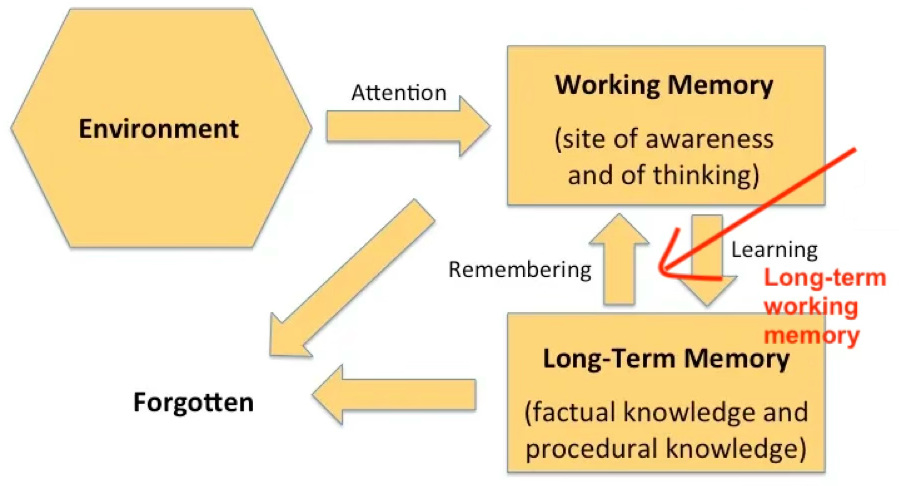
This new form of WM, which allows ideas to ‘marinate’ while we contemplate them, is thought to be supported by a mechanism called spike-timing-dependant plasticity (STDP). (37)
STDP refers to how the precise timing of spikes impacts the sign and magnitude of changes in synaptic strength, which impacts whether the knowledge gets delivered to our LTM via a process called long-term potentiation (LTP). (37)
In other words, how regularly we engage with information (timing) will determine whether that information gets stored in our LTM.
This explains why when you only read something once it is very challenging to recall it, unless it evokes a very strong emotional response.
We need to engage with something a few times to allow STDP to occur, which allows neurons to fire together to allow the formation of a new engram, which allows the new knowledge to be consolidated in our LTM.
Again, this brings to mind the phrase, ‘neural friction.’ Activity within and between neurons that consolidates knowledge and leads to a deep understanding of such.
In addition, as mentioned above, STDP ties in nicely with the theory of LT-WM, because when we engage with information over a few minutes or hours, even days, we’re stimulating STDP, which supports real-time understanding, the generation of questions about the topic under consideration, and reasoning about such.
This also explains why actively recalling knowledge from memory, vs passively reviewing it strengthens the memory of what we’ve recalled.
Similarly, it also explains why spaced repetition or spaced learning works.
Learning that is spread across practice sessions prompts the brain to consolidate the memory via repeatedly accessing such, which reinforces the engram instead of ‘cramming’ learning sessions, where the knowledge may sit in the LT-WM, but doesn’t get moved into LTM.
We’re simply reactivating and reinforcing neural connections (engrams) regularly, which allows STDP to occur, which consolidates them.
Those of you already familiar with my preference for uncovering ‘first principles,’ will appreciate this statement by Shouvel et al:
‘ … STDP is often interpreted as the comprehensive learning rule for a synapse – the ‘first law’ of synaptic plasticity.’ (38)
In other words, we need more vs less mental activity to allow for neural connections to become consolidated.
External devices rob our brain of consolidating deep knowledge
When we rely too heavily on external aids we don’t support STDP, which allows the brain to form the engrams it needs to form, which leads to knowledge being laid down in our LTM.
We may be able to recite knowledge, but we don’t have a deep understanding of what the patterns beneath the knowledge mean, and so we can’t be as creative in solving problems or in spotting mistakes.
In other words, we don’t internalise foundational knowledge so we lose out on the potential to synthesise knowledge and create new connections and insights from the knowledge laid down in deeply consolidated neural networks.
And here’s a sobering thought:
If you don’t have some knowledge to fall back on you are more susceptible to believing something that is untrue.
You don’t have an error-detection signal to rely on, because you have nothing with which to compare what you’ve just seen or heard.
The technical term for this is ‘prediction error,’ which is the gap between what your brain expected and what actually happened. (29)
The surprise we feel when our brain senses this ‘error,’ helps our brain recognise, process and learn from such errors.
Fascinatingly, when our brain spots an error, dopamine is released, which also supports memory consolidation.
Remember in Part 1 I mentioned that being motivated to learn is an important part of learning, and is linked to our neurophysiology?
Being motivated stimulates dopamine release, and dopamine is also involved with anticipation, and as you’ve just learned, is also released when we spot an ‘error’ in relation to what we expect and what we perceive.
This means we also learn from experiencing something negative - when what we thought was so, isn’t so. If we’re open to such, of course.
However, this internal error-detection system depends on having strong internal expectations available, which are built through memorisation and repeated practice of what we have learned.
Again, Oakley succinctly summarises this concept:
‘ … In short, internalised knowledge creates the mental frameworks our brain needs to spot mistakes quickly and learn from them effectively. These error signals do double-duty: they not only help us correct mistakes but also train our attention toward what’s important in different contexts, helping build the schemata we need for quick thinking. Each prediction error, each moment of surprise, thus becomes an opportunity for cognitive growth - but only if our minds are equipped with clear expectations formed through practice and memorisation.’ (29)
These findings also contradict the popular notion of unstructured discovery learning, and demonstrate that to develop expertise requires structured practice with clear and timely feedback that allows cognitive reinforcement mechanisms to optimise what we encode. (17, 29)
We don’t naturally do this well when we’re young because we don’t know how to do this.
This is why structured learning is required, not simply ‘student led learning.’

The 85% rule
Evidence has identified an optimal challenge level for effective learning, called The ‘Eighty Five Percent Rule.’
The researchers suggest that learning is best accomplished when students achieve about 85% accuracy while they practice what they’re learning. (39)
Another researcher, Vygotsky, suggested the ‘zone of proximal development’ - a sweet spot where the knowledge isn’t too easy or too difficult, which helps neural networks efficiently form and strengthen connections. (40)
This means the student is practising what they’re learning, to enable the knowledge to move into LTM.
More support for memorisation and deep knowledge acquisition …
In a 2000 article, ‘You Can Always Look It Up’... Or Can You?’ E.D Hirsch argued that broad factual knowledge enables effective skill use, which contradicted the notion that knowledge and skills are separate.
Hirsch argued that without background knowledge, students can’t evaluate sources or recognise whether information is plausible.
I’d add that we also become unable to distinguish between information (which is more plentiful than we need) vs knowledge which isn’t.
In Hirsch’s words:
‘those who repudiate a fact-filled curriculum on the grounds that kids can always look things up miss the paradox that de-emphasising factual knowledge actually hinders children from learning.’ (41)
Hirsch believed - and neuroscience today agrees - that a novice doesn’t know what they don’t know – without stored knowledge, they can’t formulate proper questions or search strategies.
To support this concept, in a classic experiment conducted by Miller and Gildea (1987), children who were told to look up unfamiliar words produced nonsensical sentences. (42)
Why?
They simply misinterpreted definitions without vocabulary context, and the lookup process itself created cognitive overload.
The children would have learned more effectively if they’d been taught the words in context rather than being told to ‘look it up.’
External resources only benefit those who already possess internal knowledge.
Again, as stated by Hirsch, ‘to be able to use that information [from the Internet] – to absorb it, to add to our knowledge – we must already possess a storehouse of knowledge.’ (42)
A perfect storm
Oakley ascertains that when schools started emphasising abstract thinking skills over content knowledge, information and computation also became instantly accessible at the push of a button. (29)
In other words, it was the interaction of these two factors, that have led us to this challenging place in modern education.
The result has been less deep knowledge acquisition and more cognitive offloading, which has led to poor neural schemata and ultimately, poor grades, with some research revealing lower IQ scores too.
For more on intelligence and the ‘Reverse Flynn Effect’ please check the article below.
Reading from a screen vs from a book - a different impact, cognitively?
Reading is a non-intuitive and cognitively demanding ability (biological secondary knowledge) which requires synchronisation between several neural networks that support vision, language processing and higher-order abilities.
Our involvement with technology means that we often read from screens, however, several studies suggest that we experience challenges when processing information from a screen vs from printed paper.
We experience changes in how we pay attention when reading from a screen compared to reading from a physical book because screens may have banners and change while we’re reading or, we anticipate that what we’re reading will be interactive, and that is a distraction in and of itself.
Reading from a physical book also involves more of our imagination, which increases comprehension vs reading off a screen.
In addition, we’re not engaged as physically with a screen as we are when we’re holding a book, turning the pages, and seeing our reading progress, physically, as the page numbers change.
In other words, more of our senses are involved with physical books vs screens.
These results provide neurobiological support for the greater cognitive load and reduced focused attention during screen-based compared to print-based reading - and learning. (43)

What about writing vs typing?
There are distinct differences between how our brains engage with writing and typing.
Handwriting is a complex neurophysiological process that integrates cognitive, emotional and motor components.
It also carries cultural and psychological significance beyond its seemingly only functional role in communication.
Think of how lovely it feels to receive a handwritten note today? It feels personal and evokes an emotional response.
Handwriting is a biological secondary knowledge acquisition, in which we have to learn how to turn language into an external, visual product, using our body.
Writing is a cognitive process that ends up producing a product and involves the coordination of our linguistic, motor, and visuospatial processes.
Conversely, typing primarily activates motor regions associated with repetitive finger movements and visual processing, with less direct engagement of areas associated with memory and language. (44)
In other words, there is less mental activity when we’re typing vs when we’re writing.
And less mental activity means that what we’re writing is more likely to engage our WM and LT-WM, which increases the chances it will be moved into our LTM.
]NOTE: Unfortunately, we can also ‘un-learn’ what we have already learned, called ‘de-skilling,’ or ‘skill-atrophy,’ but that’s for another article. However, the same neurophysiological principles underpin this cognitive loss: we need practice to retain a skill, and what we don’t use, we lose.]
But, do emotions impact learning?
Remember, we’re embodied
Social Emotional Learning (SEL) is an educational approach used in schools aimed at teaching children to understand and manage their emotions, become resilient, and includes helping them to make friends.
SEL proponents seem to have forgotten that we can’t necessarily bypass all the discomfort/s that accompany being human.
For example, we only learn how to make a friend by extending ourselves and can’t bypass the disappointment of our outreach going wrong.
This is also a learning process, and one that children need to experience and navigate through direct interactions with others.
In a recent article Anat Perry describes this process succinctly:
‘ … Such social learning depends on reliable feedback: recognising when we are mis-taken, when harm has been caused, and when others’ perspectives warrant consideration. At times, sincere empathy appears where it was not expected, revealing that another person may be trusted in the future.’ (45)
In other words, interacting with others in person is part of how humans educate themselves about how social interactions and relationships ‘work.’
Furthermore, Michael Linden a professor of psychiatry at the Charite University Hospital in Berlin, highlights that a focus on emotion hinders learning, and may be something that some educators have either never learned or forgotten. (46, 47)
We can adopt either an action orientation or a state orientation, wherein ‘action’ means focusing on the task ahead with no thought to our current physical or emotional state, and ‘state’ meaning a focus on ourselves, i.e our affective, ‘emotional’ state. (48)
If children are constantly being exposed to emotionally-laden conversations, and emotional ‘prompts’ via the SEL framework, this makes them believe that this is what they should focus on.
Their internal mental chatter has become ‘emotion-focused,’ not ‘action-focused,’ and this hyper vigilance doesn’t support mental health OR academic achievement.
This hinders the brains ability to focus on learning because the brain doesn’t have a way to engage with emotions while also paying equal attention to what’s on the curriculum.
Keep in mind that emotions travel significantly faster than cognition in the brain because emotions are how we become aware of physical, survival threats in our environment.
Most if us no longer live in environments where our physical survival is threatened, but emotions will always take precedence over cognition. (49)
In addition, moderate levels of cortisol tend to correlate with the highest performance on tasks of any type.
We can therefore conclude that moderate stress is beneficial for learning, while mild and extreme stress are both detrimental to learning. (50)
So, we need the Goldilocks effect - not too much stress, and not too little, and we get the sweet spot!
The ’85% rule’ intersects with this idea.
And, as Shrier mentions in her excellent book, ‘Bad Therapy:’
‘ … SEL may treat children as if they’re irreparably broken … and invites them to marinate in a time when they were sad or scared or vulnerable.’ (51)
Which naturally leads to chronic stress, which doesn’t facilitate an optimal learning environment.
Emotions need to be acknowledged but a focus on such hinder the learning that’s required for children to get educated. (48, 51)
So, does having fun improve learning outcomes?
The evidence reveals that while students enjoy classes more and report better experiences, the direct cognitive gains depend heavily on how humour is integrated with content.
When teachers use jokes and playfulness to reinforce key concepts, learning improves.
The best results come from activities that involve agency, diversity, peer interaction, play and low-stress settings. (52)
However, when they’re simply entertainment breaks, the benefits stay mostly emotional and social. (53)

So, is there evidence to direct us towards better learning outcomes?
Yana Weinstein and colleagues state that:
‘ … Education does not currently adhere to the medical model of evidence-based practice.’ (54)
Evidence-based medicine is defined as:
‘ … a decision-making approach integrating the best external research evidence with individual clinical expertise and patient values to guide healthcare,’ (55)
However, a definition of evidence-based education does exist.
It’s defined as:
‘ … educational practices and policies that are guided by scientifically sound research demonstrating their effectiveness, requiring the application of strong research methodologies to identify these practices.’ (56)
Researchers suggest that the field of education has made significant advances in applying cognitive processes to education and suggest six specific recommendations that can maximise students learning efficiency.
As you’ll discover, each of these six tactics are underpinned by the neural mechanisms we’ve already discussed: (56)
(1) Spaced practice:
The same amount of repeated studying of the same information spaced out over time leads to greater retention of that information in the long run, vs repeated studying of the same information for the same amount of time, in one study session.
(2) Interleaving:
Interleaving occurs when different ideas, or problem types, are tackled in a sequence, vs the more common method of attempting multiple versions of the same problem in a given study session (known as blocking).
(3) Retrieval practice:
This occurs when tests are used to encourage retrieval of stored knowledge (memories) which strengthens the memory.
(4) Elaboration:
Elaboration involves connecting new information to pre-existing knowledge, which supports the consolidation of what is already stored, while adding new knowledge. This supports a deeper understanding of what is already encoded.
(5) Concrete examples:
Concrete examples, especially for conceptual concepts, allows for supporting information that can improve the learning and consolidation of key ideas and concepts by making ideas easier to understand and remember.
(6) Dual coding:
‘A picture is worth a thousand words,’ is supported by solid evidence, because the brain quickly grasps a concept via an illustration, when it may take many words to convey the same idea. In addition, we more readily remember an image vs words. This is not the same concept as ‘learning styles,’ because dual coding refers to providing additional, complementary forms of information vs tailoring instruction to individuals’ preferences.
There are many opportunities for educators to use these tactics in combination.
Solutions to our education woes - not simply EdTech!
It should be clear to you by now why EdTech can’t solve what’s wrong with education: The brain doesn’t engage with, or perceive information it sees on a screen in the way it needs to engage with information to allow it to become deeply entrenched in neural tissue.
To allow it to become deeply held knowledge, based on understanding.
The brain doesn’t get to grapple with information and manipulate it internally in a way that allows it to become deep internal knowledge because the brain is fooled into thinking it understands what it’s seeing when all it really knows is where to find the information.
This doesn’t mean EdTech can’t be used in ways that could support knowledge acquisition, and memory and skill consolidation.
It just means it’s not being used this way currently.
When GenAI/LLM powered learning focuses on scaffolded practice and hints, vs only answers, students are prompted to engage actively with information, rather than passively consuming such.
It’s critical to understand that before students can grasp advanced concepts they need to first master what is also called factual knowledge.
This is the terminology, the definitions, and the basic common vocabulary used within a field.
Students cannot begin to grasp what they can’t name, which is the foundation for conceptual knowledge, which is where an understanding of the relationship between facts begins to emerge.
So, if you don’t have the words to explain what you’re referring to, you can’t attach an idea to other layers of knowledge.
Meaning lives within conceptual knowledge, and is built via active cognition, not passive reading.
Finally, we get to use what we know, namely procedural knowledge.
This is when we earn the ability to apply concepts to real-world problems, reason deeply, make judgment calls, and know when facts fit or don’t.
We only develop this level of knowledge - aka expertise, through deep contemplation and practice of factual and conceptual knowledge. (57)
As Thomas Sowell states so succinctly:
The purpose of education is to give the student the intellectual tools to analyse, whether verbally or numerically, and to reach conclusions based on logic and evidence.’
This type of education requires mental activity, or ‘friction,’ to deeply consolidate knowledge.
We need to use EdTech - or design it - so we can use it within the scope of how human brains actually develop, function and learn.
In summary
We’ve covered a lot but here are 20 highlights:
1) Educational outcomes aren’t improving, but rather falling generally in math, reading and science, including in comparison to countries where the US used to lead.
2) EdTech doesn’t seem to be the solution despite initial hopes to the contrary.
3) We learn though specific, cognitively-based procedures, starting with focussed, distraction-free attention.
4) Learning styles, wherein people believe they learn best according to specific senses, is a much-hyped myth.
5) Piaget, an early learning researcher observed his children to discover some foundational facts about how we learn, including that as we get older we’re able to grasp more complex concepts.
6) Our brain is very plastic during our youth, and specific periods of time are related to specific learning capacity.
7) We have different types of knowledge, namely biological primary knowledge which is how we seemingly automatically learn how to speak and recognise faces, and biological secondary knowledge, which generally requires deliberate instruction, such as being taught how to read and count.
8) We have two memory systems and we need to use them both to learn optimally which allows us to internalise information. This is in contrast to ‘The Google Effect’ which is the tendency to forget information that we know is readily available.
9) Schemata are mental frameworks that organise the data we gather and learn and neurons that fire together form engrams which are the biological foundation of memory.
10) Place or context matters in relation to how we consolidate and retrieve memories, and it’s important to note that there is a big difference between a cue about where to find a memory, vs what activates the memory itself.
11) Not all memories are consolidated in the same way and the brain actively selects which memories to strengthen, and sleep has an important role to play in such.
12) Researchers have proposed a form of memory that bridges the gap between working memory and long-term memory: namely long-term working memory which allows the brain to hold onto ideas for seconds, minutes or even hours to allow deeper contemplation before they may be moved into long-term memory.
13) External devices may rob our brain of consolidating deep knowledge, partly due to a lack of robust and deep-seated knowledge being consolidated before using external devices, which includes the inability to detect errors.
14) The 85% rule suggests that learning is best accomplished when students achieve about 85% accuracy while they practice what they learn.
15) There is support for memorisation as a foundation for deep knowledge consolidation and further acquisition.
16) A focus on abstract thinking skills over content knowledge coincided with easily accessible information and computation which are likely both contributing factors in the reverse Flynn effect.
17) Reading from a screen compared to reading from a book, impacts our brain differently because of the activation and synchronisation differences between several neural networks in relation to the two different activities. And, writing with a pen or pencil also engages more of the brain vs typing.
18) We are embodied beings and our emotions do impact how we learn, with negative emotions impacting learning negatively, and while fun can impact learning positively, it does depend on how humour is integrated with learning content.
19) They are six practical and evidenced based tactics that foster learning which can be used by educators together to improve learning outcomes. For example, spacing can be very effective for learning when it’s combined with retrieval practice and interleaving naturally entails spacing if students interleave old and new material, while concrete examples can be both verbal and visual, which actions dual coding.
20) EdTech interferes with optimal learning, because of how we engage with and process information differently via technology, which doesn’t use our brain in a way that stimulates neuronal connectivity and memory consolidation.
We can however design it to take into account how the brain develops, functions and learns, so it complements vs undermines learning.
Conclusion
When we ignore how the brain develops, functions and learns we undermine our brains natural ability to learn optimally.
However, when we understand how we learn optimally, we strengthen our neuronal capacity for knowledge acquisition, consolidation and deep reasoning.
Outsourcing our cognition, aka ‘cognitive offloading,’ doesn’t just have dire consequences for learning outcomes, it prevents the learning and practice of critical thinking and optimal decision-making.
In other words, the effects of handing over human cognition have very long reaching, negative effects.
As Oakley states succinctly:
‘In a world where we can look up almost everything, the ironic truth is that the knowledge we carry inside our heads is more valuable than ever.’ (29)
As adults, and hopefully life-long learners, and possibly parents or educators, it’s never been more important to acknowledge and work with how the brain actually develops and functions vs what smart-technology supporters believe and sell.
We make knowledge our own by engaging with it deeply, so we can use it optimally.
Let’s end this article by quoting Abigail Adams, wife of John Adams, who was not an educator, but wrote in a letter in 1780:
‘Learning is not attained by chance, it must be sought for with ardor and attended to with diligence.’
Learning isn’t a passive experience. Smart-tech has led too many to believe it is.
If you haven’t yet read or listened to Part 1, please click the button below:
NOTE: None of this content was generated by AI.
The full reference list is available for paid subscribers.